

Industrial Heating Elements: Types, Selection, and Applications
A complete technical guide to industrial heating elements — covering element types, materials, watt density, installation methods, and how to select the right solution for your process.
What Is an Industrial Heating Element?
A heating element converts electrical energy into heat through the principle of resistive (Joule) heating. When an electric current passes through a resistive conductor, the energy dissipated raises the conductor’s temperature. This heat is then transferred to the surrounding medium — air, liquid, or solid — through conduction, convection, or radiation.
Industrial heating elements are found in virtually every sector: chemical processing, food production, plastics forming, semiconductor fabrication, oil and gas, medical devices, and HVAC systems. Choosing the right element for a given application directly affects process efficiency, product quality, and equipment lifespan.
Main Types of Industrial Heating Elements
1. Tubular Heating Elements
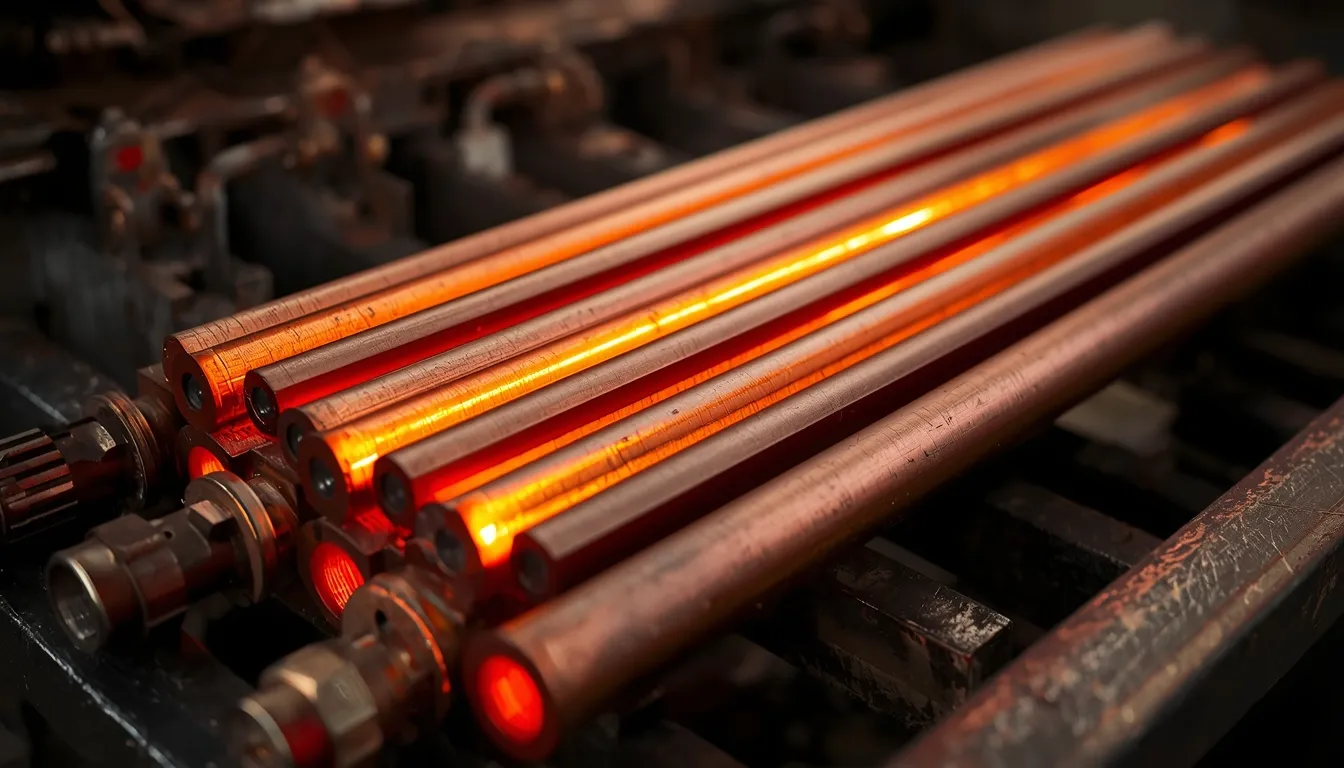
Tubular elements are the most versatile and widely used type. A resistance wire (typically nickel–chromium alloy) is centered inside a metal sheath — usually stainless steel, Incoloy, or copper — and the gap is filled with compacted magnesium oxide (MgO) powder, which provides electrical insulation while conducting heat efficiently.
Key characteristics:
- Operating temperatures up to 750 °C (sheath-dependent)
- Available straight, U-shaped, coiled, or in custom bends
- Can be used in air, water, oil, or inserted into solid blocks
- Watt density: 1 – 60 W/cm²
Typical applications: industrial ovens, water heaters, heat exchangers, steam generators, and immersion heaters for tanks.
2. Cartridge Heating Elements
Cartridge heaters are compact, high-watt-density elements designed to be inserted directly into drilled holes in metal blocks, platens, or dies. The resistance coil is wound on a ceramic core and enclosed in a stainless steel or Incoloy sheath with a precision-ground outer diameter for a close fit.
Key characteristics:
- Very high watt densities (up to 150 W/cm²)
- Diameter range: 6 mm – 25 mm, lengths up to 600 mm
- Fast heat-up and cool-down cycles
- Can be designed for temperatures up to 750 °C
Typical applications: injection molds, hot runner systems, packaging equipment, soldering tools, laboratory instruments, and semiconductor process equipment.
3. Immersion Heating Elements
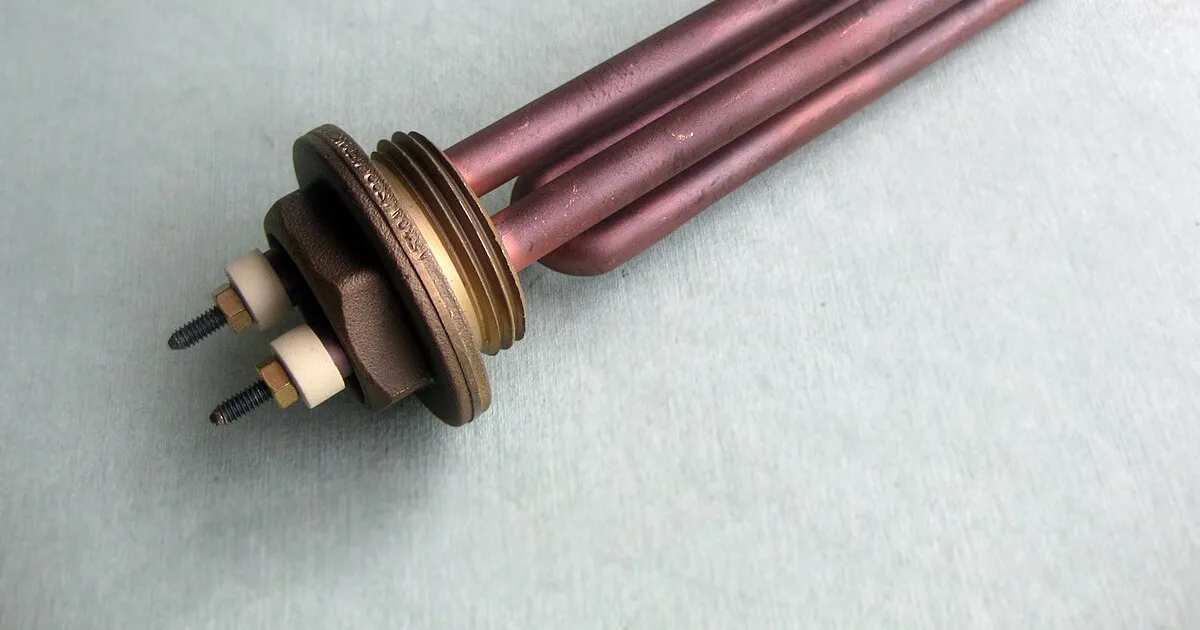
Immersion heaters are designed to be submerged directly in the fluid being heated — water, oil, acids, alkaline solutions, or chemical baths. The sheath material must be chemically compatible with the fluid.
Common sheath materials by application:
| Fluid Type | Recommended Sheath |
|---|---|
| Clean water / steam | Copper, stainless steel 316L |
| De-ionized water | Titanium, quartz |
| Petroleum / oils | Low-carbon steel, stainless steel |
| Acidic solutions | Titanium, Hastelloy, quartz |
| Alkaline solutions | Incoloy 825, stainless steel |
Typical applications: water heaters, electroplating baths, chemical reactors, swimming pool heaters, and oil pre-heaters.
4. Ceramic and Infrared Heating Elements
Ceramic elements use a resistive heating track embedded in or printed onto a ceramic substrate. Infrared (IR) elements emit radiant energy in the near-, mid-, or far-infrared spectrum, allowing contactless heating of surfaces or products on a conveyor.
Key characteristics:
- Very fast response times
- Energy-efficient for surface heating — no need to heat surrounding air
- Operating temperatures up to 1300 °C for ceramic fiber elements
Typical applications: curing ovens, thermoforming lines, paint-drying booths, food processing, and thin-film deposition.
5. Band and Strip Heaters
Band heaters clamp around cylindrical objects such as barrels, pipes, or nozzles. Strip heaters mount flat against surfaces using clamping hardware or adhesive backing. Both types transfer heat primarily by conduction into the clamped surface.
Key characteristics:
- Mica-insulated or ceramic-insulated constructions
- Mica band heaters: up to 650 °C; ceramic band heaters: up to 1000 °C
- Available in split or solid configurations
Typical applications: plastic extruder barrels, injection molding machine nozzles, pipeline heating, and heat-tracing applications.
6. Open Coil and Wire-Wound Elements
Open coil elements consist of a helical resistance wire suspended on ceramic insulators inside a duct or furnace enclosure. Because the wire is exposed directly to the air stream, heat transfer is extremely efficient, but the environment must be clean and non-corrosive.
Typical applications: industrial air-duct heaters, forced-air unit heaters, drying ovens, and furnaces processing clean, dry air.
Critical Selection Criteria
Getting the element selection right requires evaluating several interdependent parameters:
Watt Density
Watt density (W/cm²) is the heat flux at the element surface. Too high a watt density for the medium causes hotspots, premature element failure, and — in the case of liquids — boiling or product degradation at the sheath surface. As a rule of thumb:
- Still air: 0.5 – 2.5 W/cm²
- Moving air / forced convection: 2 – 8 W/cm²
- Light oils: 2 – 5 W/cm²
- Water (natural convection): 4 – 10 W/cm²
- Water (forced flow): up to 25 W/cm²
- Metal block (conduction): 15 – 60 W/cm²
Sheath Material
The sheath is the element’s primary barrier against the environment. Key selection factors are the maximum operating temperature, corrosion resistance, and thermal conductivity:
- Copper: excellent heat transfer, suitable for clean water, limited to ~250 °C
- 304/316L Stainless Steel: general-purpose, good corrosion resistance, up to ~800 °C
- Incoloy 800/840: high-temperature strength, excellent oxidation resistance, up to ~1000 °C
- Titanium: exceptional resistance to chloride and acidic environments
- Quartz: inert in most chemical environments, suitable for ultra-pure or reactive fluids
Thermocouple Integration
For precise process control, thermocouples (Types J, K, or T) can be built directly into the element sheath. This eliminates the sensor lag of externally mounted probes and provides a more accurate reading of the element surface temperature, enabling tighter control loops.
Termination and Lead Wire
Terminations must handle the application voltage, current, and ambient temperature. Common options include bare leads, high-temperature silicone or PTFE-insulated cables, terminal blocks, and quick-connect fittings. For high-vibration environments, braided stainless steel conduits or ceramic terminal heads are preferred.
Installation Best Practices
-
Fit and contact: For cartridge heaters, the drilled hole diameter should be 0.025 – 0.075 mm larger than the heater diameter. Excessive clearance dramatically reduces heat transfer and shortens element life.
-
Pre-heat immersion elements: Before energizing an immersion element, ensure it is fully submerged. Running a wet element dry — even momentarily — can cause irreversible damage.
-
Support long elements: Tubular elements longer than 400 mm in horizontal oven installations should be supported at the midpoint to prevent sagging under thermal expansion.
-
Ground the sheath: Always ground the metal sheath to prevent leakage current from reaching process fluid or the machine frame.
-
Thermal cycling: Where rapid cycling is required, specify elements wound with a lower watt density than the theoretical maximum to reduce thermal stress on the MgO fill and sheath.
Diagnosing Common Failures
| Symptom | Likely Cause | Corrective Action |
|---|---|---|
| Open circuit (infinite resistance) | Burnout from overheating | Reduce watt density; check thermostat |
| Low resistance to ground | Moisture in MgO fill | Dry out at low voltage before full power |
| Sheath corrosion / pitting | Wrong sheath material for fluid | Upgrade to compatible sheath |
| Uneven heating | Fouling or scale on sheath surface | Clean element; consider anti-scale treatment |
| Short element life in mold | Poor hole fit (excess clearance) | Re-drill hole to tighter tolerance |
Conclusion
Industrial heating elements are precision components that must be matched carefully to the thermal, chemical, and mechanical demands of each application. Understanding the trade-offs between element type, sheath material, watt density, and control strategy allows engineers to design heating systems that deliver consistent process temperatures, long service life, and minimal unplanned downtime.
For application-specific guidance or custom element specifications, contact our technical team — we can assist with thermal calculations, sheath material selection, and integration into your control architecture.
Related Articles
Types of Industrial Heating Elements: A Complete Guide
Discover the main types of industrial heating elements — tubular, cartridge, ceramic, immersion, and band heaters — and learn which one fits your application.
Temperature Sensors for Heating Elements: Thermocouples vs. PT100/RTD
Learn how to choose the right temperature sensor for your heating element system — comparing thermocouples and PT100/RTD sensors across accuracy, range, response time, and industrial application.